

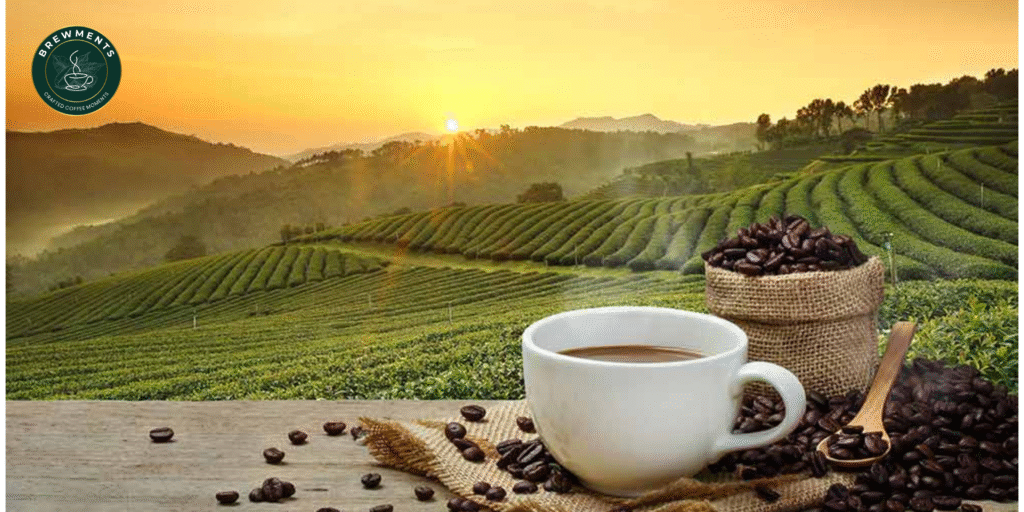
“There’s something about that first sip of a perfectly brewed cup that makes everything else feel secondary. In India, that feeling has been quietly building into something extraordinary.”
India has always had coffee. Generations of South Indian families have started their mornings with the comforting ritual of South Indian filter coffee, that slow, patient decoction poured from brass vessels with practiced wrists. But something has shifted in the last few years. Across the country, people are asking more carefully considered questions where did these beans come from, how were they roasted, what exactly am I tasting in this cup?
If you’re among those asking, you’ve come to the right place. This guide walks through what makes Indian coffee so special, the difference between the two great bean families, the regions that grow them, and most importantly where you can actually find the best quality coffee in India without spending hours down a rabbit hole of disappointing options.
India’s Coffee Story, Briefly Told
Most people don’t know that India is among the world’s oldest coffee-producing nations. Legend traces it back to the 1600s, when a Sufi saint named Baba Budan reportedly smuggled seven coffee beans from Yemen, planting them in the hills of what is now Karnataka. Whether entirely true or not, those hills Chikmagalur, Coorg, and the Bababudan Giri range still produce some of the finest coffee on the planet today.
What makes Indian-grown coffee genuinely different from its counterparts in Ethiopia, Colombia, or Brazil is the growing environment. Indian coffee is almost entirely shade-grown, under a forest canopy that slows the maturation of the coffee cherry, deepening its sugars and creating flavour complexity that is hard to replicate in sun-intensive farms. Add to that the spice-rich soil of the Western Ghats, and you begin to understand why best Indian coffee beans carry an earthy depth and natural sweetness that is unlike anything else.
“Indian coffee is shade-grown by tradition not just sustainability, but flavour. The slow cherry, the forest soil, the mountain mist. The cup you drink carries all of that history in it.”
The Regions That Matter
When people talk about premium coffee beans from India, they are almost always talking about a handful of growing regions in the southern peninsula. Each has its own character, shaped by altitude, rainfall, soil type, and the traditions of the farming communities that have worked those hills for centuries.
Coorg is arguably India’s most celebrated coffee region a lush, mist-wrapped landscape where estates have been growing coffee alongside pepper and cardamom for well over a century. The Arabica from Coorg tends to be beautifully balanced, with a soft acidity and notes that often recall dark chocolate and ripe fruit.
Chikmagalur sits at the heart of the Bababudan Hills and holds a mythological significance in Indian coffee history. The farms here are smaller and more diverse, producing both Arabica and Robusta with considerable character. If you’ve ever tasted an Indian coffee that surprised you with its depth and complexity, there’s a good chance it came from these hills.
Wayanad in Kerala produces some of India’s finest Robusta cultivated on smaller tribal and farmer-owned estates, often without the scale of the larger plantations. Wayanad Robusta has an earthy strength that is more refined than its reputation suggests.
Araku Valley in Andhra Pradesh is perhaps the most exciting emerging story in Indian coffee. This tribal-farming region has attracted significant attention from specialty roasters globally, thanks to organic cultivation practices, a distinctive terroir, and a flavour profile often described as floral, slightly fruited, and unusually clean that stands apart from anything else grown in India.
The Ritual of South Indian Filter Coffee
No conversation about Indian coffee is complete without South Indian filter coffee. If you grew up in a Tamil, Kannadiga, Telugu, or Malayali household, you already know this feeling in your bones that early-morning sound of the decoction dripping through the brass filter, the way the kitchen fills with an aroma that somehow smells like home regardless of where you actually are.
South Indian filter coffee is made in a two-chamber brass or stainless steel filter. Finely ground coffee traditionally a blend of coffee and chicory is packed into the upper chamber. Hot water is poured over it and the decoction drips slowly into the lower chamber over twenty to thirty minutes. The resulting liquid is intensely strong, almost syrupy, and deeply aromatic. It is then mixed with boiling milk and sugar and served in a traditional tumbler and davara a wide-bottomed cup with a saucer into which the coffee is poured back and forth to cool it and build a light froth.
What makes filter coffee so beloved isn’t just the taste. It is the patience built into the process, the specific ratio of coffee to chicory that each family guards with surprising conviction, and the unspoken understanding that a good cup of filter coffee is never rushed.
At Brewments, the South Indian filter coffee on the menu is brewed classically slow, strong, and with the same authentic character that the tradition demands. At just ₹50, it may be the most genuinely priced cup of culture in the entire Tricity.
What Makes Coffee “Premium”? A Straightforward Answer
The word “premium” gets used loosely in the coffee world, and that’s worth addressing honestly. In supermarket language, it often means very little a fancier label on the same commodity product. In the specialty coffee world, premium has a more specific meaning.
Truly premium coffee beans begin with traceability. You should be able to know where those beans were grown — ideally down to a specific region, estate, or cooperative. Beyond that, premium coffee is graded at origin, meaning the beans have been evaluated for defects, moisture content, and cup quality by trained tasters before they ever leave the farm.
Then comes processing. The way a coffee cherry is handled after picking whether it’s washed, naturally sun-dried, or honey-processed directly affects the flavour of the resulting bean. Each method leaves a distinct imprint. Natural processing tends to produce fruitier, wilder flavours. Washed processing reveals cleaner, more delicate notes. Honey processing sits somewhere in between.
Finally, and perhaps most critically for the home consumer there is the roast.
Why Freshly Roasted Beans Change Everything
This is the part most people don’t realise until they taste the difference for themselves. Freshly roasted coffee beans are not just a marketing phrase. They are a fundamentally different product from beans that have been sitting in a warehouse or on a shelf for months.
Coffee begins to stale relatively quickly after roasting. The CO₂ that was released during roasting continues to off-gas for several days, and during this process the beans are at their most aromatic and alive — what roasters call the “bloom” window. Within two to four weeks of the roast date, the complex volatile compounds that create the flavours you’re actually tasting begin to break down. What you’re left with after that is flat, one-dimensional, often slightly sour or cardboard-adjacent coffee.
When you buy freshly roasted beans from a source that knows what they’re doing, you will taste the difference in the very first brew. The crema on your espresso will be denser. The aroma when you grind the beans will be richer and more complex. The cup itself will have dimension — layers of flavour that reveal themselves as it cools, rather than the single flat note of stale coffee.
“A freshly roasted bean is a living thing, still releasing, still breathing. Brewing it at the right moment isn’t a detail it’s the whole point.”
Where to Actually Find the Best Quality Coffee in India
Here is the honest answer: the best quality coffee in India is not found at the large commercial chains. It is not found in the dusty pre-ground packets that line supermarket shelves. It is found at roasters and cafes that take sourcing seriously, roast in small batches, and make freshly roasted beans available without a multi-week lag between roast and sale.
One of those places is Brewments, based in Mohali, Sector 8B, Phase 8B. What began as a shared belief that coffee could be done properly in the Tricity area has evolved into a full experience a cafe where the sourcing of beans is taken as seriously as the brewing of the cup.
Brewments works with both Arabica coffee beans for smooth, flavour-forward cups and Robusta coffee beans for bold espresso-based drinks. Their Spesh Robusta blend carries honey and stone fruit notes a reminder that well-sourced Robusta is far more than just a caffeine delivery mechanism. Their Spesh Arabica offers the kind of balanced, full-bodied cup that specialists spend years refining.
Beyond the cafe, Brewments also makes their freshly roasted coffee beans available for home brewing whole or pre-ground so that the quality that shows up in the cup at their Mohali location can follow you home. It is a rare thing to find a cafe that cares enough about the home brewing experience to extend that commitment beyond its own walls.
The Brewments Philosophy
What sets places like Brewments apart isn’t a complex manifesto. It is simply the refusal to do things halfway. The beans are chosen from farms and cooperatives that follow ethical growing practices. The process from cherry to roasted bean is followed with attention and care. And the roasting is done to bring out what is already in the bean, not to mask what isn’t.
They describe their own commitment simply: “from farm to cup.” It sounds like a slogan, but when you trace it through the coffee cherries that are handpicked, sundried to preserve aroma, meticulously sorted, and then roasted by artisans who understand how each bean responds to heat it becomes something more than marketing. It becomes a method.
How to Brew Better Coffee at Home
Finding great beans is the first and most important step, but what you do with them at home matters too. A few simple practices will help you get the most out of whatever good coffee you bring home.
Buy whole beans and grind fresh. Pre-ground coffee begins losing flavour within minutes of being ground. If you have a burr grinder even an inexpensive hand grinder use it. Grind only what you need for each brew.
Store beans properly. Keep them in an airtight container, away from light and heat. Do not refrigerate or freeze beans unless you’re storing a large quantity for longer than a month. The condensation cycle of daily in-and-out from a fridge causes more damage than good.
Use the right water temperature. Water that is too hot (above 96°C) will over-extract and turn bitter. Water that is too cool will under-extract and produce a weak, sour cup. 90–94°C is generally ideal for most brewing methods. Bringing your kettle to a full boil and then waiting forty-five seconds gets you close enough.
Match your grind to your method. Coarse for French press and cold brew. Medium for filter and drip. Fine for South Indian filter and espresso. Very fine for moka pot. Getting this wrong is the most common reason a good bean produces a disappointing cup.
Respect the filter coffee decoction. If you’re brewing South Indian filter coffee at home, be patient with the decoction. Don’t rush it. A thirty-minute slow drip will always outperform a compressed ten-minute one. The tradition was built around patience, and the flavour reflects that.
A Final Word
The Indian coffee scene has come a long way from being purely an export commodity that the rest of the world enjoyed while we drank instant powder at home. Today, there are roasters, farmers, baristas, and cafes across the country doing genuinely extraordinary work and the consumer is finally beginning to catch up with them.
Whether you’re drawn to the elegance of a pour-over made with single-origin Arabica coffee beans, the satisfying punch of a well-pulled espresso built on quality Robusta coffee beans, or the irreplaceable comfort of an authentic South Indian filter coffee on a slow morning, one thing is clear: the best cup of coffee you’ve had is probably not the best cup you could have.
That next cup is out there, grown in the mist of the Western Ghats, roasted carefully in a small batch somewhere, and waiting for you to find it. At Brewments, it might be closer than you think.